
Nutraceutical Premixes: What Supplement and Functional Food Brands Need to Know
Nutraceutical premixes are pre blended mixes of vitamins, minerals, herbal extracts and other active nutrients. They serve as building blocks for dietary supplements, functional foods and fortified beverages. By combining micronutrients in precise ratios under controlled conditions, premixes let brands add complex nutrition with a single ingredient. The result is consistent potency and stability. Premix saves R&D time and ensures that a product’s label can reliably deliver on its health claims. Why Brands Use Nutraceutical Premixes Consumer demand is driving premix growth. More people now seek convenient functional foods and fortified beverages packed with extra nutrition. For example, immunity boosting nutrients like vitamin C and D surged in popularity after the pandemic. At the same time, younger consumers want energy, focus or wellness benefits in on the go formats (bars, shakes, etc.), not just tablets. Premixes let brands meet these needs quickly. Manufacturers can use a single blend of dozens of nutrients to fortify bars, drinks or capsules without developing each ingredient separately. This simplifies production and inventory: one premix replaces dozens of raw powders and reduces formulation headaches. Premixes are widely used in finished products. For example, a nutrition bar can be enriched with a vitamin mineral herb blend without affecting taste or texture. Custom premixes also allow precise targeting of dietary supplements to specific goals. A company might order a custom premix tailored for heart health, beauty or sports performance. A custom nutrient premix typically includes ten to twenty nutrients in the precise proportions needed, making it easier to add multiple vitamins and minerals without formulation errors. Premixes give brands flexibility and speed. They ensure even distribution of active ingredients batch after batch, improve mouthfeel and mask off notes and free a brand to focus on marketing. Key advantages of nutraceutical premixes include: Types of Premixes and Applications Premixes come in several major categories: Different applications require tailored formulations. Beverage premixes must dissolve easily and stay clear. Formulas often use water soluble vitamins and chelated minerals so the drink stays transparent. In India’s beverage industry, brands are adding vitamins and electrolytes to juices, energy drinks and water. Modern beverage production exemplifies the premix advantage. A clear, fortified juice needs taste free nutrient, strict FSSAI compliance and stable shelf life. In these systems, nutraceutical premixes integrate seamlessly into automated mixers, ensuring every bottle delivers the claimed nutrition. High quality premixes maintain product clarity and prevent sediment, so brands can market premium fortified drinks without upset consumers. Quality, Certification and Compliance Choosing the right premix supplier means vetting their quality systems. Any reputable nutraceutical premix manufacturer will operate in a GMP certified plant and hold ISO and food safety approvals. Livlong lists FSSAI (India’s food regulator), ISO 9001, GMP and Halal among its certifications. These credentials show the facility meets strict hygiene and traceability standards. Livlong has 3 decades of experience in serving global supplement and fortification programs, indicating deep regulatory know how. Documentation is equally vital. Every batch of a quality premix should come with complete testing: Certificates of Analysis for each raw input and the final mix, full manufacturing records, stability data and shelf life recommendations. This paperwork ensures a brand can back up its label claims and comply with FSSAI or export rules. A top premix partner functions like a science lab: you get not only the powder mix but also all proofs of quality. For Indian brands aiming for both domestic and international markets, working with an experienced local supplier offers an advantage. Livlong’s Kochi facility serves customers in over 20 countries, implying they know how to navigate both FSSAI regulations and foreign standards. Choosing a Nutraceutical Premix Manufacturer in India When selecting a premix partner, consider expertise and flexibility. The provider should collaborate on a custom premix if needed. A custom premix means you start with your ingredient list or health goal and the manufacturer develops a unique formula (with the right overages, chelation or stabilizers). Livlong emphasizes that each of its six core premix categories (vitamin, mineral, herbal, sports, etc.) can be custom formulated to fit dosage and compliance requirements. This ensures the final product works in your exact format, whether capsules, tablets or a gummy. Other key factors: look for a partner with a broad catalog of ready formulations and the R&D to tweak them. Livlong publishes featured formulas (e.g. magnesium+D3+zinc for bone health, turmeric+amla+gymnema for blood sugar) as starting points. Make sure the supplier provides ongoing support. Post launch consultation is often listed as part of their service. Ensure they have capacity and technology to match your scale (encapsulation lines, mixers for powders and liquids, etc.). A good premix partner in India will combine scientific formulation skills with full quality assurance. They should guarantee each batch with documents and certifications. This means you can trust the premix to integrate smoothly into your products and to meet labeling standards on everything from nutrient levels to shelf life. Future Trends and Outlook The nutraceutical premix market is poised to grow with wellness trends. Analysts note vitamins dominate premix use today (boosting immunity and general health) while minerals are the fastest growing segment as consumers seek well rounded nutrition. Meanwhile personalized nutrition is on the rise. People now expect products tailored by age, activity or dietary need. This means premix makers must be ready to create a wider array of formulas. Livlong calls personalized blends “the next generation” of premixes, catering to anything from cognitive support to joint health. In India specifically, health conscious consumers want immunity boosts, energy and wellness in their everyday foods. Government fortification programs (e.g. iodine or vitamin A in staples) also rely on premix providers to deliver consistent nutrients at scale. Overall, the market rewards premix partners who offer advanced formulation science. Suppliers who use chelated minerals and stabilized vitamins, as Livlong does, can ensure their products meet both label claims and consumer expectations. Brands and manufacturers that leverage high quality premixes stand to innovate quickly and remain compliant. With expert partners like Livlong supplying nutraceutical premixes backed by
How to Choose a Nutraceutical Manufacturer in India for Your Supplement Brand
A bad manufacturing partner shows up in small ways first. A capsule that’s underweight. A shipment that’s two weeks late. A label that fails FSSAI review right before launch. By the time you notice the pattern, you’ve already lost money and time. India has become one of the best places in the world to manufacture supplements. It also has thousands of manufacturers and they don’t all work the same way. Here’s what actually separates a dependable nutraceutical manufacturer from a risky one. Pick a partner built for how you plan to grow, not just for today’s order. Types of Nutraceutical Manufacturers You’ll Come Across Not all manufacturers offer the same service, so it helps to know the difference upfront. A pure contract manufacturing company produces to your exact formula and specs. You bring the recipe; they bring the equipment and the plant. A private label manufacturer, sometimes called a white label supplier, works differently. They already have a formula ready to go and you add your branding and packaging on top. This route is usually faster and cheaper for a first product. Some manufacturers also offer full custom formulation, building a new recipe from your product brief. This costs more and takes longer, but it gives you an original product instead of a rebadged one. Know which service you actually need before you start comparing quotes. Why India Leads in Nutraceutical Contract Manufacturing India’s nutraceutical market is growing rapidly, with more businesses entering the sector every year. According to CareEdge, the market was around $30 billion in 2024 and is expected to reach nearly $38 billion by 2026. By 2030, it could grow to around $57 billion. With the market expanding at this pace, there is also increasing demand for manufacturing facilities, new product formulations, and reliable nutraceutical partners. Cost is one reason global brands choose India for nutraceutical contract manufacturing. A mature pharma supply chain and skilled labour keep costs down. So does easy access to herbs like ashwagandha and curcumin. India also allows 100% foreign investment in food processing through the automatic route. International brands can contract manufacture here without a local partner first. Certifications Every Nutraceutical Manufacturer in India Should Have Certifications are the fastest way to tell serious manufacturers apart from the rest. Look for GMP certification, which covers hygiene, documentation and process control. ISO 22000 adds a food safety management layer and HALAL certification matters if you’re exporting to the Middle East. FSSAI rules work differently for this category. Most food businesses in India can run on a Basic Registration or State License based on turnover. Nutraceutical and health supplement manufacturers don’t get that choice. Since 2021, every manufacturer in this category needs a Central FSSAI license, no matter their size or revenue. If a supplier only shows you a state license, ask why. Match Manufacturing Capability to Your Product Format Not every manufacturer handles every product well. Capsules, softgels, sachets and liquids all need different machines and expertise. Ask what the plant actually runs day to day. A line built for tablets may struggle with a fish oil softgel or a collagen sachet. If you’re launching a powder, ask about filling accuracy and moisture control. Matching capability early saves you from a formula that looks perfect on paper and fails on the line. How a Reliable Supplement Manufacturer Handles Private Label Work Most new brands don’t arrive with a finished formula. They need a partner who can help build one. A good supplement manufacturer offering private label manufacturing usually follows a clear path. The process typically moves from consultation and product formulation to R&D, packaging design, regulatory documentation and production. Ask who owns the formula once it exists. Some manufacturers offer exclusive ownership or usage rights for the formulations developed specifically for your brand. Others reuse similar formulas for other clients. Settle this in writing before you sign, not after your first order ships. Ask About MOQ and Scalability Early Minimum order quantity decides whether a manufacturer fits your stage of growth. Some Indian contract manufacturing companies accept trial runs of 1,000 to 5,000 units. Others need tens of thousands of units before a batch makes sense for them. Ask what happens after your first order sells well. Can they double your volume in three months without pushing back your delivery date? If they hesitate on this answer, they may not be ready to grow alongside you. Check Export Experience Before You Scale Globally If you’re planning to sell outside India, export experience matters more than price. A manufacturer who has already registered products in the Middle East, Africa or Europe understands what those markets demand. Ask for real examples of past product registrations in your target country. Regulatory compliance looks different in Dubai than it does in Germany. A manufacturer who has done it before saves you months of back and forth with customs and local authorities. Questions to Ask Any Nutraceutical Manufacturer Before You Sign A short conversation reveals more than any brochure. Before you commit, ask: Be cautious if a manufacturer gives vague responses to these questions. A reliable manufacturer should be confident in its processes and able to provide clear, straightforward answers. Finding the Right Fit for Your Brand The right manufacturing partner works as an extension of your team, offering the expertise and support your brand needs to grow. Livlong Nutraceuticals is a GMP and ISO 22000 certified nutraceutical manufacturer based in Kerala. It handles private label and third party manufacturing across capsules, softgels, powders and liquids. Its own team guides each product from formulation to export ready packaging. If you’re building a supplement brand and want a partner who can grow with you, that’s worth a conversation.
What Makes Livlong a Trusted Nutraceuticals Manufacturer in India? A B2B Buyer’s Checklist for 2026

Choosing a contract manufacturing partner for a supplement brand comes down to a handful of hard questions: Can they meet your quality standards on paper and in the lab? Can they actually produce your volumes? And can they get your product across borders without regulatory headaches? Livlong Nutraceuticals, a subsidiary of Arjuna Natural, is one of the manufacturers Indian and international brands evaluate for exactly these reasons. Here’s what to verify before signing on — using Livlong as a working example of what a due-diligence checklist should look like. Certifications: What to Actually Check Livlong’s facility operates under GMP and ISO 22000 food safety certification, alongside FSSAI approval. These aren’t just badges GMP governs the manufacturing process itself (equipment, hygiene, documentation), while ISO 22000 covers food safety management specifically. For any manufacturer you’re evaluating, ask for: A manufacturer should be able to produce these documents on request, batch by batch, not just point to a certifications page on their website. Scientific Backing and R&D Livlong operates under Arjuna Natural, a botanical extract manufacturer founded in 1989 — meaning Arjuna brings roughly 35 years of extraction and formulation research to Livlong’s manufacturing operations. That parentage matters for B2B buyers because it means product formulations aren’t just assembled from off-the-shelf ingredients; they draw on an existing research and testing infrastructure. When evaluating any manufacturer’s R&D claims, it’s worth asking: Manufacturing Capacity and Format Range This is where vague claims are easiest to spot and easiest to verify. Livlong’s Aluva, Kerala facility runs: Beyond capsules and softgels, the facility also produces tablets, powders, and syrups — useful if you’re planning to expand a single product into multiple formats without switching manufacturers. For your own shortlist, don’t take throughput numbers at face value ask for a facility tour (virtual or in person), a sample run, or a reference client who’s ordered comparable volumes. Export Readiness If you’re planning to sell outside India, export experience is a real differentiator. Livlong currently exports to more than 70 countries across all seven continents, which speaks to a manufacturer that’s already navigated multiple regulatory regimes rather than one exporting for the first time. Questions worth asking any prospective manufacturer: Sustainability and Transparency Arjuna Natural, Livlong’s parent company, has stated a commitment to environment-friendly technologies and clean energy use at its manufacturing sites. For buyers who need this for their own brand positioning or retailer requirements, ask for specifics energy sourcing, waste handling, water usage rather than a general sustainability statement, since practices vary a lot between “we recycle packaging” and formal environmental certification. On transparency, a reliable manufacturing partner should provide COAs and batch documentation as a default part of every shipment, not something you have to request each time. 2026 Buyer’s Checklist What to check Why it matters Valid GMP, ISO 22000, FSSAI (and Halal/Kosher if relevant) Confirms baseline manufacturing and food-safety compliance In-house formulation team and named ingredient science Signals real R&D depth, not just repackaged formulas Documented throughput for your required format and volume Confirms they can actually deliver at your scale Prior export experience in your target country Reduces regulatory friction and registration delays Standard-issue COAs, MSDS, and shelf-life documentation Protects you if a batch is questioned by a retailer or regulator Format flexibility (capsules, softgels, powders, syrups) Lets you expand your line without changing manufacturers Frequently Asked Questions Is Livlong a manufacturer or a consumer brand? Livlong is primarily a B2B contract and private-label manufacturer. It also has a consumer-facing co-brand, CureGarden, through which some of its formulations reach individual buyers directly. Where is Livlong’s manufacturing facility located? Aluva, Kerala the same region where its parent company, Arjuna Natural, was founded and is headquartered. What product formats can Livlong manufacture? Capsules, softgels, tablets, powders, and syrups, produced across dedicated lines for each format. How many countries does Livlong export to? Livlong states it exports to more than 70 countries across all seven continents, per its own published export figures. What should I ask for before signing a contract manufacturing agreement? At minimum: current certification copies, sample COAs, a documented production timeline for your order volume, and references from an existing client with comparable requirements. Conclusion Vetting a nutraceutical manufacturer comes down to verifiable specifics rather than general claims of trustworthiness: valid certifications you can check yourself, documented production capacity, and export experience in the markets you actually care about. Livlong’s certifications, Aluva-based manufacturing infrastructure, and export footprint give B2B buyers concrete points to verify — which is the standard any manufacturer on your shortlist should be able to meet. Sources / References
Nutraceutical Contract Manufacturing Timeline: From Formulation to Launch

Many new supplement brands ask, “How long will it take from concept to shelf?” The nutraceutical contract manufacturing process covers every step, from ideation and formulation through full scale production and packaging. Outsourcing to a contract manufacturer speeds up launch by avoiding costly factory builds. In fact, Livlong’s own blog notes that our turnkey service lets brands skip “years of setup” and tap proven production lines. Still, realistic planning is key: experts estimate a new custom supplement often takes about 3–5 months (12–20 weeks) from formula approval to finished product. Knowing the typical lead time at each stage helps brands set a practical launch schedule. Livlong’s full spectrum contract manufacturing service helps minimize delays. We handle R&D, sourcing, production and packaging under one roof. Our experts coordinate every phase and give clear timeline estimates at each step. By partnering with Livlong, brands gain a transparent production schedule – from idea through approval to shelf ready product. We also identify potential bottlenecks: complex custom formulas, unique packaging options or new regulatory requirements can extend any timeline, so we plan accordingly. For example, a unique bottle design might add days to weeks for tooling and approval whereas sticking to standard formats keeps turnaround fast. In summary, a typical nutraceutical contract manufacturing process runs several months from initial formula to market launch. Each stage has its own lead time, but knowing the breakdown avoids surprises. With experience managing this production cycle, Livlong can help you set a realistic schedule. Ready to launch your supplement? Learn more about our Custom Manufacturing services or contact us to plan your product timeline with our team.
Nutraceutical Premixes Explained: How Pre-Formulated Blends Simplify Supplement Manufacturing
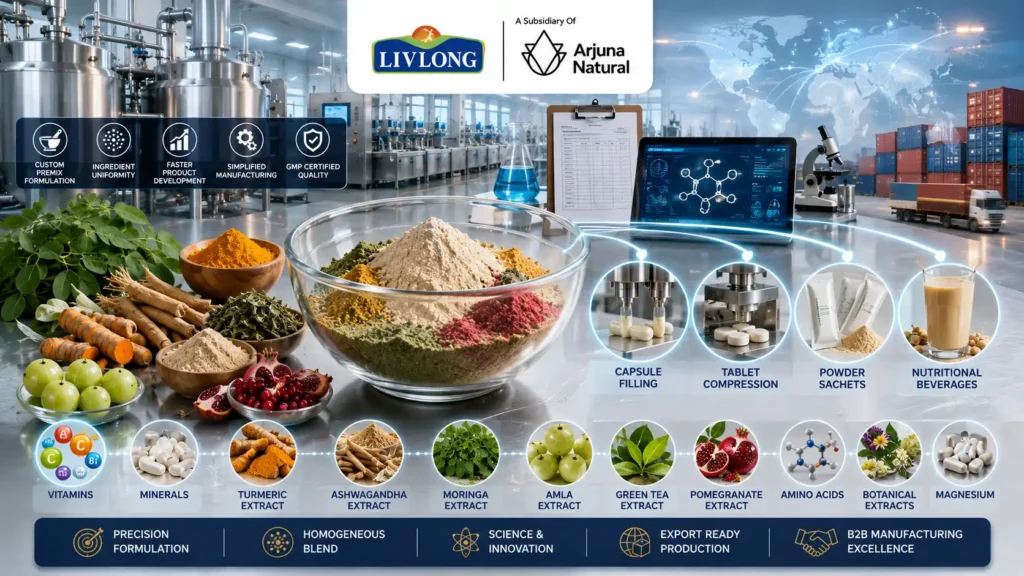
Every supplement brand eventually hits the same wall: a formula that looks simple on paper becomes a logistical headache in production. Sourcing ten different actives from five vendors, testing each one individually, then trying to blend them to a uniform potency across a 500 kg batch — it’s slow, expensive, and full of places where things can go wrong. This is the problem nutraceutical premixes were built to solve. A premix is a pre-blended, quality-tested combination of vitamins, minerals, herbal extracts, or amino acids, formulated in exact ratios and ready to move straight into capsule filling, tableting, or your food and beverage base. Instead of managing ten supply chains, you manage one. Instead of testing ten raw materials, you receive one certificate of analysis for the finished blend. For manufacturers, private label brands, R&D teams, and procurement managers working in India’s fast-growing nutraceutical sector, understanding how premixes work — and what separates a well-engineered one from a generic powder blend — is becoming essential product development knowledge. Table of Contents What Is a Nutraceutical Premix? A nutraceutical premix is a homogeneous, pre-formulated blend of active ingredients — vitamins, minerals, standardized herbal extracts, amino acids, or combinations of all four — manufactured to a fixed ratio and tested as a single unit before it ever reaches your production line. Instead of a formulator combining, say, Ashwagandha extract, melatonin, and magnesium at your facility, a premix manufacturer does that formulation work upstream: sourcing each raw material, verifying potency, calculating stability-safe ratios, and blending under controlled conditions. What arrives at your factory is one ingredient, not five — ready for capsule filling, tablet compression, or incorporation into a powder, food, or beverage matrix. This is different from buying a “custom formulation” service in the abstract. A premix is a physical, testable product with its own specification sheet, batch number, and certificate of analysis — which is precisely what makes it easier to build a compliant, defensible label claim around. Why Brands Are Shifting to Premix-Based Manufacturing The move toward premix sourcing isn’t a trend — it’s a response to real operational pressure points that most growing supplement brands run into. Ingredient uniformity. Blending multiple actives in-house, batch after batch, introduces variance. A premix is homogenized and tested for uniformity before it leaves the manufacturer’s facility, so every capsule in every batch carries the same dose. Reduced formulation complexity. A ten-ingredient formula becomes a single SKU to procure, store, and quality-check. This matters most for brands without a large in-house formulation science team. Faster product development. Working from an existing, validated premix — or a close variant of one — compresses the time between concept and first production run. Many premix manufacturers maintain formulation catalogues covering common health categories, which shortens the R&D cycle considerably compared to building a formula from raw actives. Improved manufacturing efficiency. Fewer incoming materials means fewer receiving inspections, fewer CoAs to reconcile, and less risk of a single out-of-spec ingredient delaying an entire production run. Enhanced bioavailability, where applicable. Reputable premix manufacturers select ingredient forms — chelated minerals over inorganic salts, for example, or piperine ratios calculated for curcumin absorption — specifically to improve how well the finished product performs against its label claim. Scalable manufacturing. A premix that’s been formulated and tested at pilot scale can typically be scaled to commercial volume without reformulation, because the ratios and blending parameters are already validated. Regulatory documentation. Every batch should come with a certificate of analysis, batch manufacturing record, and ingredient traceability report — documentation that’s far harder to assemble when you’re sourcing and blending ten raw actives independently. GMP-certified production. Because the blending happens in a controlled, audited facility rather than on your own floor, you inherit the manufacturer’s quality system rather than having to build one in-house. Custom formulations for global markets. A premix manufacturer with export experience can adapt a formula’s ingredient forms or dosage to match FSSAI, GCC, EU, or US regulatory frameworks before it reaches your facility. Brands exploring these advantages typically start by reviewing what’s already available through an established nutraceutical premix manufacturing partner rather than building a formulation program from scratch. Premix Sourcing vs. Individual Ingredient Procurement Factor Individual Ingredient Sourcing Premix Sourcing Number of vendors managed One per raw material One (the premix manufacturer) Quality testing burden Every incoming material tested separately One CoA for the finished blend Blending accuracy Dependent on in-house equipment and process Controlled, validated blending ratios Formulation development time Weeks to months Often days, if using a proven blend Batch-to-batch consistency Variable, process-dependent Standardized and documented Regulatory documentation Assembled internally, ingredient by ingredient Provided as a single technical package Scale-up risk Higher — process may not translate to volume Lower — ratios pre-validated for scale Ideal for Brands with dedicated in-house formulation teams Brands prioritizing speed, consistency, and lean operations Neither approach is universally “better” — brands with deep in-house R&D capability sometimes prefer full control over sourcing. But for most private label companies, product developers working against a launch deadline, and procurement teams managing multiple SKUs, premix sourcing removes a significant amount of operational risk. Core Categories of Nutraceutical Premixes Premix manufacturing spans a wide range of health categories, each requiring a different formulation approach. Below is a breakdown of the major categories currently in active production, along with representative ingredient combinations and delivery formats. Antioxidant & Cardiovascular Health Antioxidant premixes typically combine botanical extracts with vitamins C and E to support cellular protection, while cardiovascular-focused blends lean on polyphenol-rich extracts. Format: primarily capsules. Stress, Sleep & Adaptogen Blends Adaptogen-based premixes are among the most requested categories, driven by consumer demand in the stress and sleep segment. Format: capsules. Joint Health & Inflammation Management Blood Sugar & Diabetic Support This is a category where mineral and botanical actives are frequently combined for a more comprehensive metabolic support profile. Format: capsules. Liver Support & Detoxification Immunity & Anti-Inflammatory Support Hair, Nail & Skin Health (Beauty-From-Within) Unlike most other categories, these formulas are typically delivered as flavored powders
What to Look for in a Nutraceutical Contract Manufacturer in India

As your supplement business in India grows, partnering with the right nutraceutical manufacturer can make all the difference. India’s supplement industry is growing rapidly, making it essential for B2B brands to partner with manufacturers known for quality, innovation and regulatory compliance. In this blog, we explore the key factors to consider like certifications, manufacturing capabilities, customization and more to ensure your contract manufacturing supplements process runs smoothly and safely. By the end, you’ll know how to pick a manufacturer that builds your brand’s authority and offers strong support at every step. Certifications & Regulatory Compliance Consumers demand safe, consistent supplements. A top contract manufacturer should hold international certifications. Look for GMP (Good Manufacturing Practice), ISO 22000, FSSAI licenses and even WHO GMP or Halal certifications. These confirm the facility follows strict quality standards and regulatory guidelines. For example, Livlong’s site highlights contract manufacturing backed by GMP certification, ISO 22000 food safety standards and complete regulatory compliance. In practice, this means they test raw materials and products at every stage and keep full documentation. Ensure your manufacturer guarantees all lab tests, certificates and paperwork are in place. This level of batch consistency and traceability builds trust, both with regulators and end customers. Quality Assurance & Testing Quality control should be nonnegotiable. An experienced partner will perform rigorous quality assurance on every batch. They should check potency, purity and safety using certified labs and standard protocols. For instance, Livlong explains that “all our products undergo rigorous quality control and testing to ensure they meet the highest standards of safety and efficacy”. As a client, ask how samples are tested (e.g. HPLC, microbiology) and how out of spec issues are handled. A dependable manufacturing partner is usually transparent about these details through its website and client discussions. Transparent reporting is key: you want detailed certificates of analysis for each production run. Also look for facilities comply with industry standards and complete documentation to know they treat quality as a priority. Manufacturing Capabilities and Scale Your manufacturer’s production capabilities must match your needs. Can they make your product in different formats (capsules, tablets, softgels, powders, gummies, etc.) and handle your desired volumes? Check their equipment and factory size. Many reputable companies emphasize their state-of-the-art machinery and large scale production capabilities. For instance, Livlong features an automated capsule production line capable of filling up to 40,000 capsules every hour, along with dedicated softgel manufacturing facilities to support high volume demand. This scalable production capability allows manufacturers to support your business at every stage, from pilot batches to large scale commercial production. It is an added advantage when a contract manufacturer can manage small batch production for startups and early stage product launches. This flexibility lets you test formulas on a budget before committing to large quantities. Custom Formulation and R&D Expertise One important consideration is whether the manufacturer maintains an in-house R&D department staffed by chemists and nutrition experts. A strong contract partner will offer formulation development support, helping you create a unique product or improve an existing one. They should provide bespoke blends and adapt formulations for vegan organic or allergen free markets. For example, Livlong highlights custom blends for immunity, digestion, beauty and more. Verify that the manufacturer invests in research: good ones mention ongoing trials for bioavailability, new actives or delivery technology (like liposomal encapsulation). This shows commitment to innovation. In short, prioritize partners who emphasize scientific credibility and can source specialty ingredients. Patented ingredients and clinical grade extracts can help differentiate your product in a competitive market. Packaging, Branding and Private Label Support Even the best formula needs appealing packaging. Look for a manufacturer that offers private label nutraceuticals services and design support. Look for a manufacturer that offers complete packaging support, from label artwork and printing to multiple packaging formats such as bottles, sachets and blister packs. Livlong, for instance, provides in house design services and eco friendly packaging options. They describe helping brands create eye catching labels while meeting sustainability goals. A full service partner will also ensure packaging meets regulatory requirements (like FSSAI labeling rules). Ask if they can apply your logo and colors (custom branding) and whether they have ready to market private label formulas. Quick turnaround on labeling approvals and secure warehousing can be real advantages. Livlong’s packaging comes with comprehensive documentation and certificates to prove compliance. In sum, your contract manufacturer should simplify the packaging process so you can focus on sales and marketing. Transparency and Partnership Finally, a good manufacturer is a true partner. Communication and transparency matter. They should keep you updated on production timelines, costs and any unexpected issues. A reliable manufacturing partner should openly communicate project progress through detailed reports and transparent processes. Livlong reinforces this by promising full transparency throughout product development. Also consider the company’s track record: do they export globally? International clients mean they understand multiple regulatory frameworks. Review their customer testimonials or case studies. The right manufacturing partner focuses on your success by offering tailored solutions rather than just fulfilling orders. When you talk to them, notice if they listen to your needs and offer proactive suggestions. B2B owners value long term partnership, not just a transactional vendor. After vetting all these factors, you’ll be better equipped to choose a trustworthy nutraceutical manufacturer partner for your supplement business in India. Prioritize firms that balance cutting edge manufacturing technology, strict quality assurance and collaborative service. By doing so, you ensure your brand’s supplements are built to last and backed by evidence and compliance. If you’re ready to expand your supplement line with a reliable third party manufacturer, Livlong Nutraceuticals offers the full spectrum of services you need. Livlong brings science backed nutraceutical manufacturing services that ensure complete regulatory compliance, consistent quality assurance and scalable production capabilities. Ready to grow your supplement brand? Contact Livlong to request a partnership quote and discuss tailored manufacturing solutions.
Quality Control Standards Every Supplement Brand Should Demand
Consumers expect supplement to be safe and effective. Also, they want it to be accurately labeled. People often pay more for clinically proven and high quality supplement products. That means brands must invest in strict supplement quality assurance and thorough quality control. Rigorous standards ensure every dose is potent and safe. Dangerous contaminants or falsified ingredients can slip into the supply without precise standards. Why Quality Control Matters Quality issues in supplements are more than just marketing problems. They can be health hazards. Regulators and researchers have found cases of poor quality products. For example, the FDA recently warned that certain “natural” weight loss pills actually contained a poisonous plant (yellow oleander) instead of the advertised herb. Studies have found many illicit supplements remained on the market after warning. Even more troubling is that they still containing banned drugs. These incidents highlight that how lac of quality controls can affect trust and safety of brands. Quality assurance is crucial for supplements to build customer trust. Compromising on quality may boost short term profits but the reputational costs can be high. Good Manufacturing Practices (GMP) and Regulations Good Manufacturing Practices (GMP) are central to any quality program. These are legal standards that require clean production and testing. In the U.S., supplement companies must follow FDA’s 21 CFR Part 111 which mandates setting specifications for identity, purity, strength and contaminant limits. World Health Organization calls it GMP. GMP is the aspect of quality assurance that ensures products are consistently produced and controlled to quality standards. It also makes sure processes and product testing meet the intended standards. GMP means using validated equipment, following detailed protocols and keeping full batch records. Many countries require GMP. India’s FSSAI mandates GMP based hygiene and quality controls. A GMP certified facility automatically meets these rules and smooth export and retailer approval. GMP certification or quality seal on a label provides a quick signal to customers that the product follows recognized safety protocols. Rigorous Testing and Verification supplements need thorough testing at every stage beyond GMP. Every ingredient and finished batch should be checked for identity, potency, purity and safety. Reputable manufacturers quarantine new raw ingredients and run exhaustive analyses. One leading nutraceutical maker note that “every batch of raw material that enters our facility goes into ‘quarantine.’ We test it for heavy metals like lead and mercury. We also check for microbes like E. coli or mold.” Testing then continues through production. These checks catch any mix ups before packaging. All tests must use scientifically valid methods. These safety tests are critical. Numerous studies show traditional remedies can carry toxic metals if not carefully controlled. One review found many herbal supplements with lead or arsenic far above safe limits. A reputable brand will only release a batch that passes all these tests and will provide a Certificate of Analysis (COA) as proof. A COA documents the lab results and confirms each ingredient and the final product meets its quality specs. Third Party Certification Internal QC is vital, but independent certification adds trust. Organizations like NSF International and USP conduct independent audits of supplements. NSF/ANSI 173 certification reviews product labels and runs toxicology and contaminant tests on items. NSF also retests certified products annually in its accredited labs to ensure they consistently match their label claims. A supplement carrying the NSF or USP Verified seal has been vetted by unbiased experts confirming it contains exactly what the label claims and no unsafe contaminants. Building Consumer Trust All these quality steps feed into one goal, the trust. Today’s consumers look for evidence of safety and honesty. Brands that highlight their science and quality processes earn more credibility. Mentioning tests and certifications on labels or websites shows expertise and transparency. Publishing lab reports or audit certificates demonstrates that the brand stands behind its claims. Having qualified scientists or pharmacists involved in formulation and QC adds authority. Brands that demonstrate these qualities stand out. Companies build lasting credibility when they support their claims with data and third party validation. Conclusion Demanding rigorous quality control is non-negotiable for any supplement. Companies must enforce GMP compliance, exhaustive testing and transparent documentation to protect customers and their reputation. Every supplement needs defined specs for identity, purity, strength and safety as FDA rules make clear. Meeting these requirements isn’t just a legal duty; it’s good business. Superior supplement quality assurance sets a brand apart in a crowded market after all. Customers can trust that the supplement will deliver on its promise safely when every claim is backed by real data.
Choosing the Right Manufacturing Partner for Long-Term Brand Growth
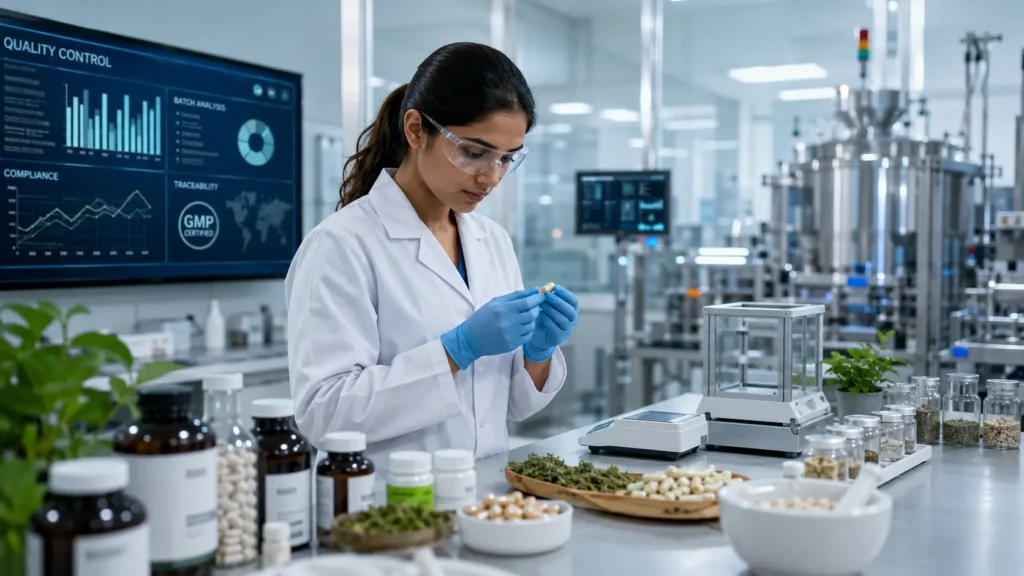
Choosing the right manufacturing partner for supplements is like picking the right copilot for a cross country flight. It can make or break your journey. The global nutraceuticals industry was valued at about $500.6 billion in 2025. It is projected to double by 2034. Indian market may reach $60 billion by 2030. Assuring quality, safety and trust are crucial for such explosive growth and consumer demand. Continuing brand success depends on a partner who shares your values and meets strict standards. This blog will guide you through the process of selecting nutraceutical partner. The highlight is on key criteria to ensure safety and compliance of your supplements. The Foundation: Quality, Compliance and Certifications Quality control and regulatory compliance are nonnegotiable. A top tier nutraceutical partner will have GMP certified facilities, ISO accreditation and adherence to FSSAI (or FDA) guidelines. GMP (Good Manufacturing Practices) is a global standard. in the U.S. it’s codified in FDA’s 21 CFR Part 111 and India’s FSSAI mandates GMP based hygiene and quality checks. This means every raw ingredient is tested and traced. Each production step is documented and skilled staff follow strict procedures. A reliable manufacturer maintains an approved vendor list and performs rigorous incoming ingredient test including identity assays, microbial screens and heavy metal analyses. They provide full ingredient traceability from source to finished product and often share batch certificates and lab test results. A certified facility not only ensures safety but also instills trust. Implementing GMP significantly enhances product safety, reduces contamination risks and ensures reproducibility. Always ask potential partners for their latest third party audit reports or inspection records. It’s a red flag if a facility cannot produce an FDA inspection or GMP audit on request. Reliable partners will gladly provide documentation of quality assurance processes and COAs (Certificates of Analysis). This transparency is critical as trust in a nutraceutical brand starts with trust in its maker. Transparency and Traceability Builds Trust A trustworthy manufacturer makes transparency a priority. Is it possible to verify the origin of every ingredient? Modern nutraceutical companies increasingly use digital tracking platforms and blockchain based solutions to ensure complete end to end ingredient traceability. They will openly share documentation like supplier audits, Certificates of Analysis and testing reports for raw materials and finished products. Look for partners that support quality management systems (like ISO 9001, ISO 22000, or HACCP) to guarantee consistency. Clear communication channels are also key. Your partner should be willing to answer questions about processes in detail. Ask how they prevent cross contamination or if they conduct third party lab testing on finished products. Slow or vague responses can signal trouble. Good partners provide detailed QA reports and they invite audits or virtual tours of the facility. Such transparency strengthens customer confidence. Key Evaluation Checklist Innovation and R&D: Beyond Just Production A strong manufacturing partner contributes more than machines to bring innovation. Do they have research and development staff (nutritionists, food scientists, pharmacists) on hand? Their expertise should help optimize your formula for stability and efficacy. The right partner will discuss dosage forms (capsules, powders, gummies, etc.) and even prototype small batches to ensure the product works as intended. Look for a partner that asks questions about your target customer and product goals. Sophisticated CDMOs often offer clinical trial support and analytical testing (HPLC, stability studies) to back up your claims. This scientific backing is an advantage. More companies are conducting clinical trials to validate their nutraceutical products to give a competitive edge. Your ideal partner should act as a development partner than a manufacturer. A manufacturer without proven R&D expertise, well-equipped laboratories, documented quality processes and a strong history of innovation may struggle to support your long-term business growth. Capacity, Cost and Collaboration Choosing a manufacturer based only on the lowest price can compromise quality and long term success. Extremely low quotes can indicate corners being cut in raw materials or testing. A reliable partner justifies their price with service including sourcing ingredients, handling testing, manufacturing and packaging. They allow you to focus on marketing and sales while they cover the technical side. Compare quotes carefully. The list of services (formulation, scale up, private labeling, fulfillment) can vary between manufacturers. Make sure that your partner can grow with you. The manufacturer should be able to scale production without sacrificing lead times while your business grow. Ask about equipment and automation. Modern lines with capacity for expansion are a plus. Confirm flexibility by checking whether they hold capacity for your orders. Ask the following. What percentage of your current production capacity is available for new clients and how do you prioritize production scheduling during high demand periods? A good partner will give frank answers about lead times, MOQs and scheduling. Shared Values and Sustainability Consumers value more about ethics and sustainability than just product performance. A partner who shares your brand values can enhance your reputation. If you market clean label or vegan supplements, confirm the manufacturer can certify products for those claims (non GMO, allergen free, halal, etc.). Ask about their sourcing practices and certifications (organic, kosher, etc.). Brands with sustainability commitments should also inquire about eco friendly packaging options and waste reduction programs. Embracing sustainability is a good PR. More consumers are choosing brands that actively prioritize environmental sustainability. Choosing a partner with clean energy usage, minimal waste and ethical labor practices not only helps the planet but also builds trust with conscious customers. Make sure your nutraceutical partner selection reflects your own commitment to ethics and social impact. Building Trust through Partnership Trust in your partner is as crucial as trust in your product. Verify their regulatory standing by requesting documentation. Always ask to see copies of their most recent FDA or FSSAI inspection results and any third party audit certificates. Test their transparency with tough questions Notice their responsiveness. A reliable partner will provide detailed answers and guidance than generic marketing jargon. Before signing any agreement, take time to assess the manufacturer’s strengths in formulation development, GMP compliance, R&D,
Private Label Supplement Manufacturing: A Guide for Emerging Brands
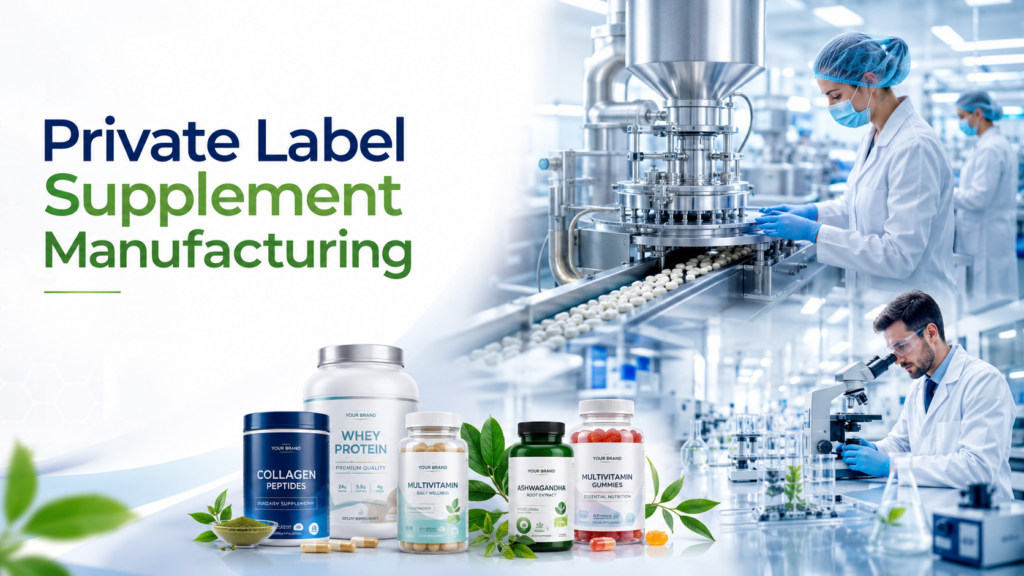
The global supplement market is booming, valued at over ₹19.14 lakh crore in 2025 and still growing. In fact, the private label supplement segment is projected to reach nearly ₹22.03 lakh crore by 2030. This opens up significant opportunities for emerging brands. Many startups today skip building a factory. They rely on Private label supplement solutions to bring products to market faster. Working with an experienced contract manufacturer allows you to concentrate on growing your brand while the manufacturer manages formulation, testing and packaging. What Are Private Label Supplements? Private label supplements are products made by contract manufacturers and sold under a retailer’s brand. Unlike generic “white label” products, private label formulations let you customize ingredients, dosage forms and labels. Many companies market vitamins, protein powders or herbal capsules that are manufactured through an OEM partner. These products are labeled with the retailer’s own brand. Benefits of Private label supplement solutions Key Steps in Private Label Manufacturing Manufacturers guide brands through a step by step process, from concept to shelf. Livlong, a leading nutraceutical contract manufacturer, highlights the following stages:: Choosing the Right Manufacturer Not all contract manufacturers are equal. When vetting a partner, consider: Choosing the right custom supplement manufacturer can make or break your brand. The best ones act as true partners, sharing knowledge and putting quality first. Conclusion In summary, Private label supplement solutions give emerging brands a fast, low risk path to market. In today’s competitive wellness market, speed and credibility matter. By partnering with a GMP certified manufacturer, you leverage their science backed expertise and facilities. This means your supplements will be safe, effective and credible to consumers, while you focus on growing your business. With the right partner and product strategy, you can launch your supplement line with confidence, quality and speed.
Fish Oil vs Plant Based Omega 3: Manufacturing and Sourcing Insights
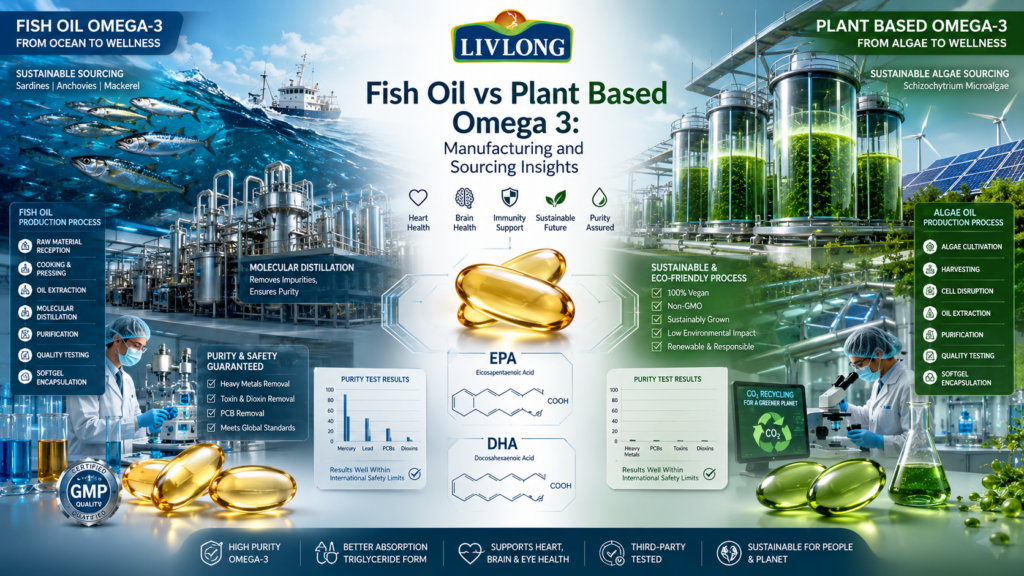
Omega 3 fatty acids (EPA and DHA) support heart, brain and overall health. Not all omega-3 supplements are produced from the same sources. In this blog we compare fish oil and plant based omega 3 sources. This omega 3 sourcing comparison looks at how each type is made, purified and tested. Understanding these differences helps you pick the right supplement for your needs. Fish oil is harvested from oily fish like sardines, anchovies and mackerel. Fish accumulate EPA and DHA by eating marine algae in the ocean. The raw oil must be purified before it can be used. Manufacturers like Livlong start with premium sardine oil and use molecular distillation to strip out heavy metals, PCBs and other toxins. The result is a high purity oil rich in EPA and DHA. This oil is then sealed in softgel capsules, protecting the oil from oxidation. Fish oil supplements come as softgel capsules containing purified omega-3 concentrates. For instance, Liv Long manufactures fish oil capsules with high EPA and DHA content free from heavy metals. Each batch is tested for purity and potency, ensuring consistent omega 3 content. Encapsulation protects the oil from oxidation and strict GMP/ISO standards help verify contaminant levels and safety. Plant based omega 3 can refer to different sources. Some come from seeds like flax, chia and walnuts, which contain alpha linoleic acid (ALA). The body converts ALA into EPA and DHA, but this conversion is very inefficient (only about 0.5–4%). In contrast, microalgae provide EPA and DHA directly. Algal oil is extracted from single cell algae, the natural source of marine omega-3s, cultivated on land.Unlike fish oil, algal omega 3 is manufactured entirely within controlled production facilities. Microalgae such as Schizochytrium are grown in tanks or ponds, fed nutrients, CO₂ and light (or plant sugars). After harvesting, the oil is extracted using advanced methods such as ultrasonic, enzymatic, or supercritical CO₂ techniques to preserve its quality. A recent review highlights that algae derived oils have very consistent EPA/DHA content, no fishy odor and no ocean pollutants. This controlled cultivation avoids the heavy metals and PCBs that accumulate in wild fish. Manufacturing and Purification Processes Fish Oil: After fish are caught, their flesh is cooked and pressed to separate the oil. The key purification step is molecular distillation, which removes impurities. As Livlong explains, “The oil undergoes advanced molecular distillation to remove heavy metals, toxins and environmental contaminants, meeting global safety standards”. This yields a molecularly distilled fish oil that is safe and highly concentrated in EPA and DHA. The clean oil is then encapsulated or bottled for use. Algal Oil: Microalgae cultivation also involves key processing steps. After growth, the algal cells are broken open (via drying, milling, or enzymes) to release the oil. The oil is extracted using solvents or CO₂. Modern techniques, such as enzymatic extraction or hydrothermal liquefaction, improve yield while reducing energy use. Because algae are grown in clean tanks, the crude oil is already free of mercury and most ocean pollutants. The final algal oil is then refined and concentrated for supplement use. Sustainability and Quality Comparison Sustainability and purity are important in the omega 3 sourcing comparison. Fish oil depends on marine fisheries. Overfishing and ocean health are real concerns: a recent review notes the sustainability of fish derived omega 3 is in question “due to overfishing, inconsistent omega 3 contents and potential contamination in the ocean”. Wild fisheries must be managed carefully. On the positive side, fish oil production has a well-established supply and is generally less expensive. Algal omega 3 is often seen as more sustainable. Algae can be grown year round without harming wild fish stocks. OmegaQuant notes algal oil can be produced in controlled, ecofriendly facilities that capture CO₂ and use renewable inputs. Because algae act as carbon sinks, their cultivation may even lower greenhouse emissions. The advanced cultivation and processing methods make algal supplements more expensive. Algal oils offer a cleaner source of omega 3 by naturally minimizing marine contaminants. Fish oils must be carefully purified, but good manufacturers test every batch for heavy metals, PCBs and potency. Both fish and algal omega 3 can meet strict nutraceutical standards if processed correctly. Always look for third party certifications and lab results on labels, whether you choose a marine or plant based source. Key Takeaways In conclusion, both fish oil and plant-based omega-3 follow reliable and well-established production processes. The quality and sustainability of the oil are largely determined by its processing methods. This omega 3 sourcing comparison shows that the best choice depends on your values and needs. Choose a reputable brand that tests its omega 3 oils for purity and potency and pick the source (marine or algal) that aligns with your diet and eco preferences. if you are interested in omega3 supplement distribution cllick the button below
