
Every supplement brand eventually hits the same wall: a formula that looks simple on paper becomes a logistical headache in production. Sourcing ten different actives from five vendors, testing each one individually, then trying to blend them to a uniform potency across a 500 kg batch — it’s slow, expensive, and full of places where things can go wrong.
This is the problem nutraceutical premixes were built to solve.
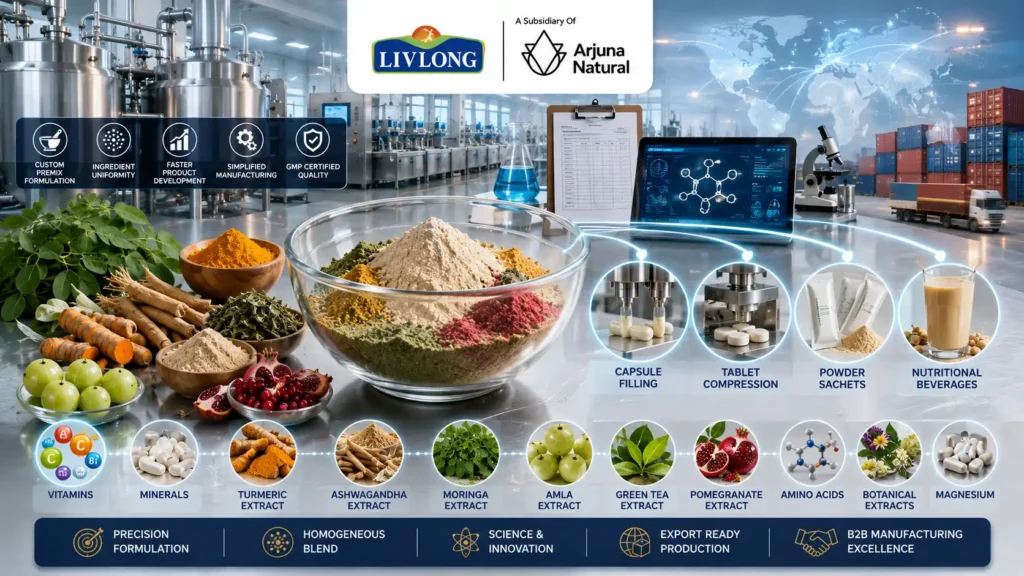
A premix is a pre-blended, quality-tested combination of vitamins, minerals, herbal extracts, or amino acids, formulated in exact ratios and ready to move straight into capsule filling, tableting, or your food and beverage base. Instead of managing ten supply chains, you manage one. Instead of testing ten raw materials, you receive one certificate of analysis for the finished blend.
For manufacturers, private label brands, R&D teams, and procurement managers working in India’s fast-growing nutraceutical sector, understanding how premixes work — and what separates a well-engineered one from a generic powder blend — is becoming essential product development knowledge.
Table of Contents
- What Is a Nutraceutical Premix?
- Why Brands Are Shifting to Premix-Based Manufacturing
- Premix Sourcing vs. Individual Ingredient Procurement
- Core Categories of Nutraceutical Premixes
- What to Look For in a Premix Manufacturing Partner
- Key Takeaways
- FAQs
- Conclusion
What Is a Nutraceutical Premix?
A nutraceutical premix is a homogeneous, pre-formulated blend of active ingredients — vitamins, minerals, standardized herbal extracts, amino acids, or combinations of all four — manufactured to a fixed ratio and tested as a single unit before it ever reaches your production line.
Instead of a formulator combining, say, Ashwagandha extract, melatonin, and magnesium at your facility, a premix manufacturer does that formulation work upstream: sourcing each raw material, verifying potency, calculating stability-safe ratios, and blending under controlled conditions. What arrives at your factory is one ingredient, not five — ready for capsule filling, tablet compression, or incorporation into a powder, food, or beverage matrix.
This is different from buying a “custom formulation” service in the abstract. A premix is a physical, testable product with its own specification sheet, batch number, and certificate of analysis — which is precisely what makes it easier to build a compliant, defensible label claim around.
Why Brands Are Shifting to Premix-Based Manufacturing
The move toward premix sourcing isn’t a trend — it’s a response to real operational pressure points that most growing supplement brands run into.
Ingredient uniformity. Blending multiple actives in-house, batch after batch, introduces variance. A premix is homogenized and tested for uniformity before it leaves the manufacturer’s facility, so every capsule in every batch carries the same dose.
Reduced formulation complexity. A ten-ingredient formula becomes a single SKU to procure, store, and quality-check. This matters most for brands without a large in-house formulation science team.
Faster product development. Working from an existing, validated premix — or a close variant of one — compresses the time between concept and first production run. Many premix manufacturers maintain formulation catalogues covering common health categories, which shortens the R&D cycle considerably compared to building a formula from raw actives.
Improved manufacturing efficiency. Fewer incoming materials means fewer receiving inspections, fewer CoAs to reconcile, and less risk of a single out-of-spec ingredient delaying an entire production run.
Enhanced bioavailability, where applicable. Reputable premix manufacturers select ingredient forms — chelated minerals over inorganic salts, for example, or piperine ratios calculated for curcumin absorption — specifically to improve how well the finished product performs against its label claim.
Scalable manufacturing. A premix that’s been formulated and tested at pilot scale can typically be scaled to commercial volume without reformulation, because the ratios and blending parameters are already validated.
Regulatory documentation. Every batch should come with a certificate of analysis, batch manufacturing record, and ingredient traceability report — documentation that’s far harder to assemble when you’re sourcing and blending ten raw actives independently.
GMP-certified production. Because the blending happens in a controlled, audited facility rather than on your own floor, you inherit the manufacturer’s quality system rather than having to build one in-house.
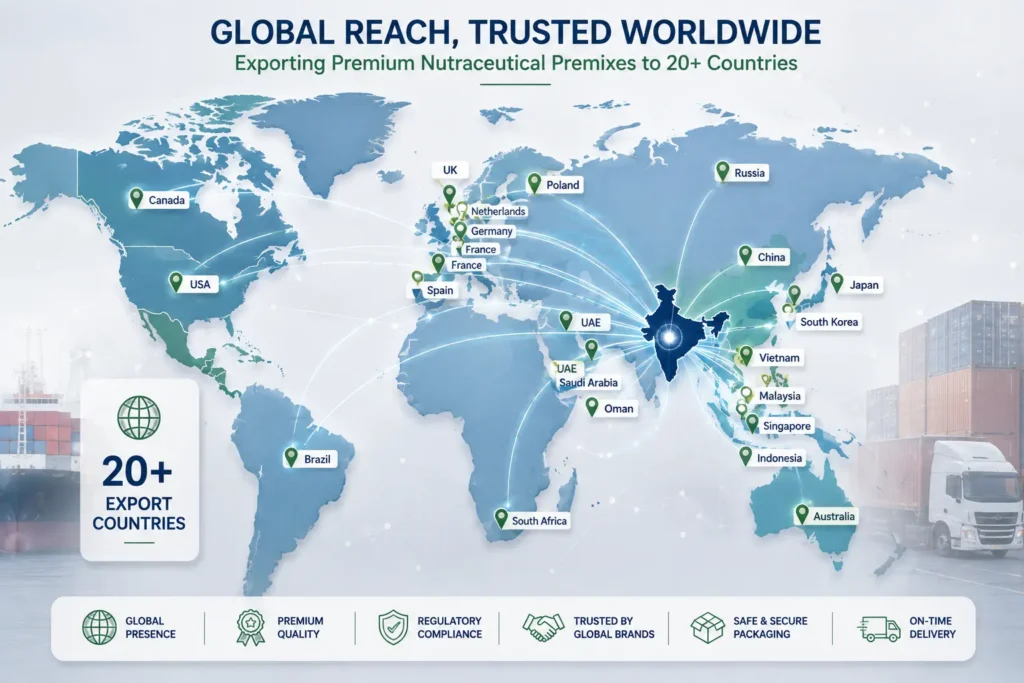
Custom formulations for global markets. A premix manufacturer with export experience can adapt a formula’s ingredient forms or dosage to match FSSAI, GCC, EU, or US regulatory frameworks before it reaches your facility.
Brands exploring these advantages typically start by reviewing what’s already available through an established nutraceutical premix manufacturing partner rather than building a formulation program from scratch.
Premix Sourcing vs. Individual Ingredient Procurement
| Factor | Individual Ingredient Sourcing | Premix Sourcing |
|---|---|---|
| Number of vendors managed | One per raw material | One (the premix manufacturer) |
| Quality testing burden | Every incoming material tested separately | One CoA for the finished blend |
| Blending accuracy | Dependent on in-house equipment and process | Controlled, validated blending ratios |
| Formulation development time | Weeks to months | Often days, if using a proven blend |
| Batch-to-batch consistency | Variable, process-dependent | Standardized and documented |
| Regulatory documentation | Assembled internally, ingredient by ingredient | Provided as a single technical package |
| Scale-up risk | Higher — process may not translate to volume | Lower — ratios pre-validated for scale |
| Ideal for | Brands with dedicated in-house formulation teams | Brands prioritizing speed, consistency, and lean operations |
Neither approach is universally “better” — brands with deep in-house R&D capability sometimes prefer full control over sourcing. But for most private label companies, product developers working against a launch deadline, and procurement teams managing multiple SKUs, premix sourcing removes a significant amount of operational risk.
Core Categories of Nutraceutical Premixes
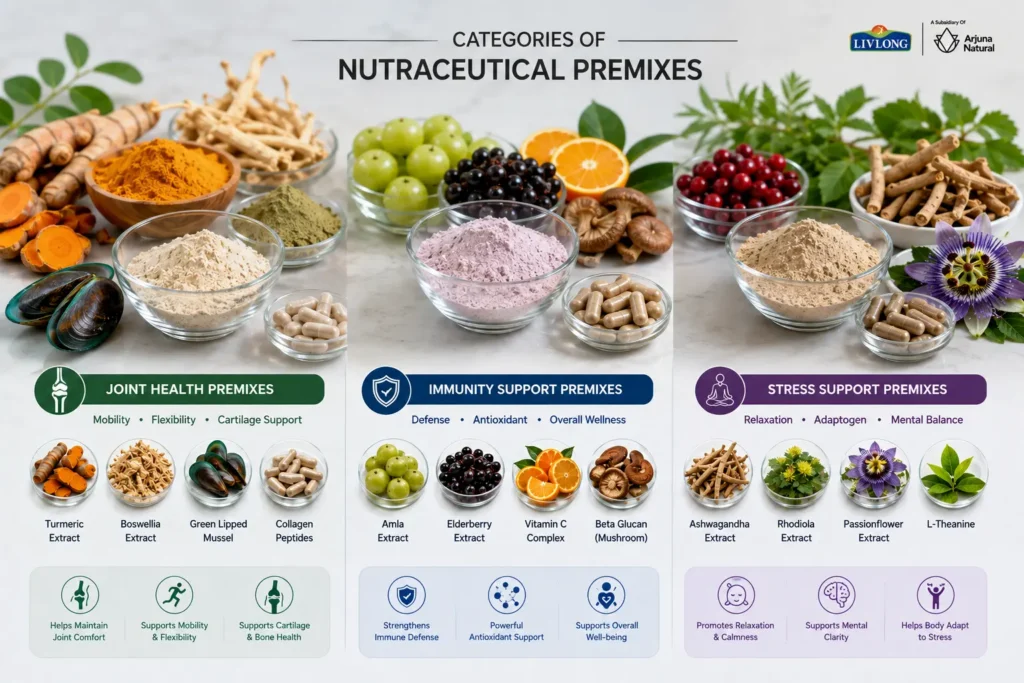
Premix manufacturing spans a wide range of health categories, each requiring a different formulation approach. Below is a breakdown of the major categories currently in active production, along with representative ingredient combinations and delivery formats.
Antioxidant & Cardiovascular Health
Antioxidant premixes typically combine botanical extracts with vitamins C and E to support cellular protection, while cardiovascular-focused blends lean on polyphenol-rich extracts.
- Green tea extract with vitamins C and E — general antioxidant support
- Tinospora, amla, and moringa extract combinations — antioxidant and cardiovascular support
- Pomegranate extract with resveratrol — heart health
- Pomegranate extract with red spinach extract — cardiac health
Format: primarily capsules.
Stress, Sleep & Adaptogen Blends
Adaptogen-based premixes are among the most requested categories, driven by consumer demand in the stress and sleep segment.
- Standardized Ashwagandha (Shoden) combined with 1.5% withanolide extract and melatonin — stress and sleep support
- Ashwagandha Shoden with 1.5% extract alone — stress and sleep, without added melatonin for markets with restrictions on it
- Ashwagandha Shoden with 1.5% extract and magnesium gluconate — stress and relaxation
Format: capsules.
Joint Health & Inflammation Management
- Glucosamine HCL with turmeric and Boswellia extract — arthritis management
- Turmeric extract with Boswellia extract — joint pain
- Turmeric extract, Boswellia extract, and sesame oil — musculoskeletal support, delivered as a softgel for improved absorption of the fat-soluble actives
Blood Sugar & Diabetic Support
This is a category where mineral and botanical actives are frequently combined for a more comprehensive metabolic support profile.
- Turmeric, amla, and pterocarpus extracts — diabetic management
- Turmeric, amla, and gymnema extract — diabetic management
- Turmeric, amla, and gymnema extract with added magnesium, zinc, and vitamin D — a more comprehensive metabolic support formula
Format: capsules.
Liver Support & Detoxification
- Milk thistle, dandelion, Picrorhiza kurroa, and Phyllanthus niruri extracts — general liver support
- A more complex seven-botanical liver blend combining Andrographis paniculata, Curcuma longa, Tinospora cordifolia, Phyllanthus niruri, Zingiber officinale, Emblica officinalis, Picrorhiza kurroa, and Berberis aristata
Immunity & Anti-Inflammatory Support
- Turmeric extract with inulin — immunity and inflammation
- Turmeric extract with vitamin C and zinc — immunity and inflammation
- Turmeric extract with piperine — immunity and inflammation, formulated for improved curcumin absorption
- Turmeric extract with nano curcumin and piperine — a higher-bioavailability variant of the above
- Green tea, turmeric, amla, Andrographis paniculata, and ginger root extract with vitamin E — combined strength and immunity formula
Hair, Nail & Skin Health (Beauty-From-Within)
Unlike most other categories, these formulas are typically delivered as flavored powders rather than capsules — a format choice that matters for consumer compliance in daily-use beauty supplements.
- Fish collagen, biotin, L-glutathione, hyaluronic acid, and vitamins C and E
- Fish collagen, L-glutathione, hyaluronic acid, and Tata fos with piña colada flavoring
- The same base formula in a watermelon flavor variant
Format: powder.
Male Performance & Vitality
- A multi-botanical male performance formula combining horny goat weed, Tongkat Ali, shilajit, Mucuna pruriens, saw palmetto, ginseng, ginkgo biloba, Ashwagandha (Shoden), Tribulus terrestris, Avena sativa, maca root, and L-arginine
- Shoden, Ashwagandha extract, vitamins B6, B9, and B12, and zinc citrate — general vitality support
- Pomegranate extract, zinc citrate, lycopene, and vitamin B6 — prostate health
Cognitive & Memory Support
- Bacopa extract, ginkgo biloba extract, Centella asiatica extract, L-tyrosine, vitamin B12, and folic acid — memory enhancement
Weight Management
- Garcinia extract, green tea extract, cinnamon, and ginger extracts — a thermogenic-leaning weight management formula
Multivitamin & Mineral Systems
- Magnesium glycinate with vitamin D3, B6, and zinc — anxiety, bone health, and blood sugar support
- A general vitamin-mineral premix combined with turmeric powder, ginger extract, and pomegranate extract
- Vitamin-mineral premix with L-arginine, L-methionine, L-cystine, and L-lysine — hair growth formula
- Amla extract with vitamin C — a natural vitamin C formula
Brands developing products in any of these categories can typically start from an existing formulation rather than building one from zero — a full herbal extract-based premix portfolio spanning liver, joint, immunity, cognitive, and metabolic categories is already in active production and export.
What to Look For in a Premix Manufacturing Partner
Choosing a premix supplier is a formulation decision, not just a procurement one. A handful of factors separate a dependable long-term partner from a vendor you’ll outgrow within a year.
Certifications and regulatory standing. At minimum, look for FSSAI licensing, GMP (ideally WHO-GMP) certification, and ISO 9001. If you’re exporting to Gulf or Southeast Asian markets, Halal certification is close to non-negotiable. Bureau Veritas certification and MSME registration are additional signals of an audited, accountable operation.
Formulation science, not just blending. Ask how the manufacturer decides between ingredient forms — magnesium glycinate versus oxide, for instance, or how a piperine ratio is calculated against a specific curcumin dose. A partner who can explain why a blend is built the way it is has real formulation expertise behind it.
Standardized extracts. Herbal premixes should use extracts standardized to a verified active marker concentration, not generic botanical powder. This is the difference between a formula that performs consistently and one that varies batch to batch based on raw crop quality.
Testing depth. Every batch should carry a certificate of analysis covering potency, heavy metals, and microbial counts, with in-process sampling confirming uniformity during blending — not just a finished-product spot check.
Documentation and traceability. You should be able to trace a finished premix batch back to individual raw material lot numbers. This matters enormously if you ever face a regulatory audit or a product recall.
Scale flexibility. A partner who supports pilot-scale runs for market validation, as well as large-scale commercial volumes, lets you test a formula without committing to inventory you can’t yet sell.
Export and multi-market regulatory experience. If you sell — or plan to sell — outside India, a manufacturer already preparing documentation for FSSAI, UAE, EU, and US import requirements will save you significant regulatory back-and-forth.
| Certification | What It Signals |
|---|---|
| FSSAI | Baseline Indian food safety compliance |
| WHO-GMP | Controlled, audited manufacturing process |
| ISO 9001 | Documented quality management system |
| Halal | Access to GCC and Islamic-majority export markets |
| Bureau Veritas | Independent third-party quality verification |
| MSME (Govt. of India) | Registered, accountable Indian manufacturing entity |
A manufacturer offering this full documentation stack as standard — rather than on request — is generally a stronger long-term partner. Liv Long’s nutraceutical premix manufacturing operation, for example, issues a certificate of analysis, batch manufacturing record, and regulatory documentation package with every batch as a default, not an add-on.
Key Takeaways
- A nutraceutical premix is a pre-blended, quality-tested combination of actives — not just a formulation concept, but a physical, documented product.
- Premix sourcing reduces the number of vendors, tests, and points of failure in your supply chain compared to sourcing raw actives individually.
- Herbal premixes should use standardized extracts with verified active concentrations, not generic botanical powder.
- Format matters: beauty and hair/skin blends generally perform better as flavored powders; joint and musculoskeletal actives often ship as softgels for fat-soluble absorption.
- Certifications (FSSAI, GMP, ISO 9001, Halal) aren’t paperwork formalities — they directly determine which export markets are open to you.
- Scalability from pilot batch to commercial volume should be validated before you commit to a formula, not discovered after.
FAQs
What exactly is a nutraceutical premix?
It’s a pre-blended combination of vitamins, minerals, herbal extracts, or amino acids, formulated in fixed ratios and tested as a single ingredient before it reaches your production line — ready for capsule filling, tableting, or incorporation into a food or beverage base.
How is a premix different from ordering a custom formulation?
A custom formulation is a service; a premix is the resulting product. Once a formulation is finalized, it becomes a premix — a discrete, batch-tested item with its own specification sheet and certificate of analysis, which can be reordered consistently.
Do premixes work for private label brands, or only large manufacturers?
Premixes are particularly useful for private label and smaller brands, since they remove the need for in-house formulation science and multi-vendor ingredient sourcing. A brand can often launch from an existing catalogue formulation rather than developing one from scratch.
Can herbal extract premixes be customized, or are they fixed formulas?
Most manufacturers offer both: a catalogue of proven formulations ready to scale, plus custom development against a brand’s specific ingredient, dosage, and regulatory requirements. Standardized extract percentages and delivery format can usually be adjusted for a target market.
What formats do nutraceutical premixes come in?
Capsules are the most common format, but powders (particularly for beauty and hair/skin blends) and softgels (typically for fat-soluble actives like turmeric-boswellia-sesame oil combinations) are also widely used, depending on the ingredient profile and target consumer.
How do premixes affect product development timelines?
Significantly. Starting from a validated, already-tested formulation compresses the R&D phase from months to a much shorter window, since the ratio work, stability considerations, and initial testing have already been done.
What certifications should I check before choosing a premix manufacturer?
FSSAI and GMP certification are baseline requirements. ISO 9001 indicates a documented quality management system, and Halal certification is important if you’re exporting to Gulf or Southeast Asian markets. Ask specifically whether these certifications cover the facility producing your premix, not just the parent company.
Is premix manufacturing cost-effective compared to sourcing raw ingredients separately?
For most brands, yes — not necessarily on a per-kilogram ingredient basis, but on total cost, once you account for reduced testing overhead, fewer vendor relationships to manage, lower blending error risk, and faster time to market.
Conclusion
The shift toward premix-based manufacturing isn’t about cutting corners — it’s about moving formulation complexity to a partner who’s built the systems to manage it properly. For brands trying to launch faster, scale predictably, and meet regulatory requirements across multiple markets, working from a well-engineered, GMP-certified premix is often the more defensible choice than assembling a formula from raw actives in-house.
Whether you’re building a stress-and-sleep formula, a joint health blend, or exploring a category you haven’t touched before, the fastest starting point is usually an existing, validated formulation with the option to customize it against your specific brand requirements.
Looking to simplify your next product launch?
Liv Long Nutraceuticals manufactures GMP-certified vitamin, mineral, and herbal extract premixes across more than 100 formulations, with export experience in 20+ countries and over three decades of formulation expertise. Whether you need a ready-to-scale blend from our catalogue or a fully custom formulation built around your brand’s requirements, our team handles the science so you can focus on the market.
