
Consumers today expect more than just a catchy label; they demand safe and effective supplements. The global supplement market keeps growing (projected at $67.4B in 2024), and people are willing to pay extra for clinically proven, high quality products. Good Manufacturing Practices (GMP) are the bedrock of this trust. GMP certified production means every step, from clean facilities to batch testing, follows strict quality rules. This ensures each supplement is safe, pure and consistent. In short, GMP compliance is not just bureaucratic red tape; it’s what keeps consumers safe and brands credible in a competitive industry.
What Is GMP in Supplement Manufacturing?
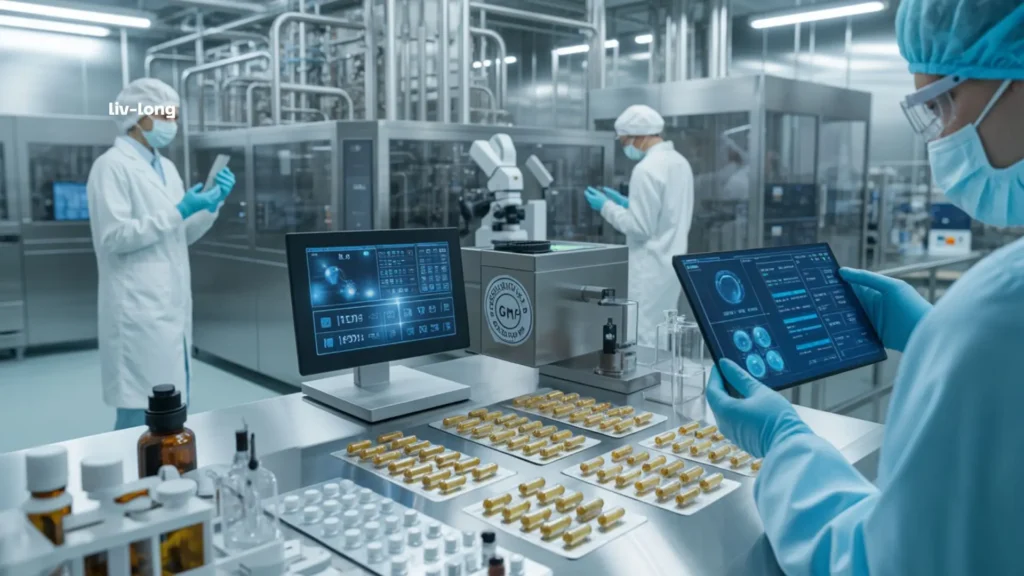
GMP stands for ‘Good Manufacturing Practices’. It’s a global quality system that controls people, facilities, equipment, materials, and records to ensure consistent, safe products. The FDA, WHO and other regulators require GMP for dietary supplements. For example, the FDA’s CGMP rules cover everything from hygienic staff practices and plant design, to equipment maintenance and sanitation. In supplements, GMP means every raw ingredient is tested and traced, each production step is documented, and skilled staff follow written procedures. The World Health Organization similarly defines GMP as quality assurance that “ensures products are consistently produced and controlled to the quality standards appropriate to their intended use”. In practice, GMP is the difference between random recipes and reliable, lab tested nutraceuticals.
Ensuring Safety and Consistency
At its core, GMP protects consumer safety. By enforcing clean facilities, trained workers and validated processes, GMP minimizes risks of contamination, mix ups, or dosage errors. Supplements without GMP controls have been linked to mislabeling and dangerous impurities. In fact, before strict GMP inspections, the FDA found hundreds of products tainted with unapproved drugs. Following GMP means testing each ingredient for identity and quality before use, and running in process checks so every capsule or tablet matches its formula. The result is ‘consistent quality’: every batch meets the same safety and potency standards. Customers get what they expect every time, and brands avoid the nightmare of recalls or injury claims. As industry experts note, GMP “prioritizes the safety of end users by minimizing the risk of contamination or inconsistencies” and skipping it can lead to recalls and reputational damage.
Building Trust with Certification
In the crowded supplement aisle, GMP certification is a badge of credibility. Consumers and retailers look for the GMP logo as proof of trustworthy production. Surveys show a majority of people (about 75% of Americans as of 2024) take dietary supplements, and they use GMP status as a key filter when choosing brands. A GMP certified manufacturer must keep full batch records and labels, so you can trace every ingredient from source to shelf. This transparency reassures customers that nothing was cut corner. Third party audits, like NSF or USP GMP checks, add another layer of confidence: laboratories verify the content and labels independently. Brands can then market the science behind their product, citing purity tests and GMP compliance as proof. In short, GMP builds loyalty. High quality, consistent supplements lead to repeat customers and positive reviews, while non-compliance can erode trust.
Meeting Regulatory Standards
GMP isn’t optional, it’s often the law. In the U.S., dietary supplement makers must follow FDA’s 21 CFR Part 111 for cGMP. In India, FSSAI regulations require GMP based hygiene and quality controls for nutraceuticals. For export markets, WHO’s GMP guidelines and international food safety standards (ISO 22000/HACCP) are baselines. By running a GMP certified facility, a manufacturer automatically satisfies many global regulators. This means your product can enter more markets with less hassle. In fact, Livlong is certified under all major bodies (ISO, FSSAI, GMP, Halal, etc.), smoothing exports worldwide. When a plant holds those stamps of approval, finished supplements easily comply with regulations, from label claims to contaminant limits. In practice, GMP compliance protects the business from fines, import holds or bans. It’s the most efficient way to prove your products meet modern legal standards globally.
Global Market Access
With GMP certification, a supplement brand can sell internationally. Many countries demand GMP as a precondition for import or retail partnership. For example, an ISO 22000 food safety system or NSF/ANSI supplement certification is recognized by overseas distributors as proof of quality. This opens doors: combining GMP with third party audits shortens vendor qualification and builds buyer trust. WHO GMP principles and ISO safety systems are accepted in supply chains worldwide. In fact, tens of thousands of ISO HACCP based food safety certifications exist globally, showing broad acceptance. When your supplement bears GMP certification, foreign regulators see a known standard at work, making cross border sales and partnerships smoother. In the modern market, GMP isn’t just a local checkbox; it’s a passport to international opportunities.
Livlong’s Commitment to GMP Quality
At Livlong, GMP is part of the company’s DNA. Every Livlong product undergoes rigorous testing for purity, potency and safety, and is made in an ISO 22000 and GMP certified facility. For example, Livlong’s omega 3 softgels use advanced ICP MS testing to guarantee they’re heavy metal free (no mercury or lead). The result: every batch is safe and contamination free. Livlong also follows all global standards, FSSAI, ISO, Halal, etc., providing full documentation (certificates, COAs, label approvals) for each batch. This means partners can confidently launch products with correct labels, knowing regulators will see all evidence of compliance. In practice, Livlong’s high speed GMP protocols and strict quality checks ensure that formulas based on Ayurveda or modern nutraceutical science are reliable. Brands partnering with Livlong gain a trusted manufacturer so they can “focus on their vision while ensuring products are science driven and compliant”.
Best Practices in GMP Certified Production
A GMP certified facility follows documented procedures at every stage. Staff are well trained and monitored, equipment is regularly maintained, and cross contamination is prevented by scheduling and sanitation. Raw materials undergo identity and purity tests before use. Production follows written batch records, so steps can be audited later. After manufacturing, samples from each batch are tested for correct strength, dissolution, microbes, heavy metals and more. Any deviations trigger corrective actions (CAPA) to fix problems fast. At Livlong, for instance, every product meets Indian and international norms before release, and customers receive batch test reports and certifications. Such traceability builds trust: if an issue ever arises, ingredients can be traced backward to the supplier, or the entire batch can be recalled safely.
Risks of Non Compliance
Skipping GMP comes at a price. Regulators have repeatedly taken action against companies that neglect GMP. Although compliance can be costly upfront, failing to follow it can lead to even bigger losses. A single GMP violation can trigger FDA warning letters, forced recalls or bans on products, not to mention consumer lawsuits. For example, warning letters have been issued to supplement firms for missing specifications and test records, leading to expensive shutdowns. Even without official action, poor quality products spark bad reviews and erode brand loyalty. Modern consumers often check for GMP or third party seals before buying. In contrast, GMP compliant brands gain industry recognition as leaders in quality. In short, GMP compliance is an investment in reputation and risk management: it averts the costly mistakes that can happen with rushed or negligent manufacturing.
Conclusion: Trust and Transparency in Supplements
In today’s supplement industry, GMP compliance isn’t optional. It’s the foundation of safety, quality and trust. By insisting on “GMP certified supplement production”, brands demonstrate respect for consumers and the law. They prove that every capsule is backed by science, strict testing and global quality practices. Companies like Livlong lead by example: their GMP certified facilities, R&D rigor and full documentation mean you can sell products with confidence. For consumers, that translates into peace of mind. For businesses, it builds loyal customers and opens markets worldwide. Ultimately, GMP compliance binds the entire industry together in a commitment to honesty and excellence, the very qualities modern health conscious customers demand.
